Discussion on mental health has always been in the closet in India. Suicide by prominent Bollywood actor, Sushant Singh Rajput, has brought the topic to the forefront. People from all walks of life are coming up with their stories and experience about struggling with depression, mental illness.
But, how long can we expect such a trend to go on? Our traditional society has usually downplayed mental health issue, which has been considered the sickness of wealthy people who can afford the counsellors. According to the World Health Organisation, India has the most significant number of mental illness cases and has labelled India as the most depressing country. The question is – are we doing so wrong? If yes, how can we make India happy again?
We have always been a close-knitted society. Due to urbanisation, nuclear families, irregular working hours, people to people contact has drastically reduced especially in the metro cities. An unhealthy lifestyle is also causing stress and anxiety among the younger lot. Recent lockdowns, the negativity surrounding Covid-19, rumours on social media and job losses have worsened the situation.
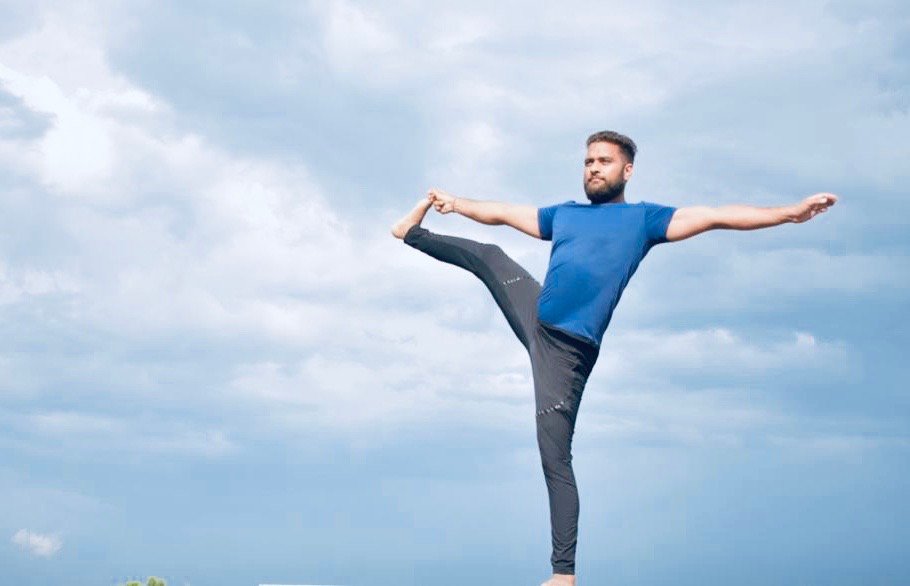
The balance between mind and body has always been essential. India is the land of spirituality, and our sages have done thousands of years of contemplation on the connection between mind, body and the universe. Maharshi Patanjali, around 3000 years ago, organised and summarised yoga from various old practices and created Yog Sutra, which is the most significant gift to the modern world. Yoga has originated from the word Yug, which means to connect. So a straightforward definition of yoga can be a technique which unites the body with the mind.
The great thing about yoga is that it’s never too late to start yoga practices. For all those beginners, who wish to awaken their self-conscience through yoga, a 30 minutes sequence is listed below that can make a big difference –
Morning cleaning practices (Shatkarma) – Six kinds of Shatkarmas have been described in yoga practice such as – Neti, Dhauti, Nauli, Basti, Kapalbhati and Tratak. For beginners, Jal-Neti and Kapalbhati are sufficient for cleaning the nasal cavity and purifying the frontal region of the brain. A jal-neti pot is easily available and can be ordered online.
Pranayam
Try to start your day by waking up early around 6 am. Jal Neti is ideally performed before the Pranayam. Pranayam can be carried out in the sequence of Bhastrika, Kapalbhati, Anulom Vilom, Bhramari and OM chanting. A total of 10 minutes pranayama for a beginner is good to start with.
Sun Salutation (Surya Namaskar)
For a beginner, 8 to 10 rounds of sun salutations are good and gradually can be increased to 50 to 60 rounds. In winters, it is advised to do some subtle warm-up before sun salutation.
Camel Pose (Ushtrasana)
Hold the pose for few seconds at the beginning, which can later be increased to 3 to 4 minutes. It’s suitable for the digestive and reproductive system. It stimulates spinal nerves, relieves back-ache, stretches the neck and regulates the thyroid gland. It is also helpful for people who have asthma.
Bow pose (Dhanur Asana)
Abdominal organ, kidney and muscles are massaged, and this asana reconditions the entire elementary canal. It improves blood circulation and respiration.
Shoulder stand pose (Sarvangasana)-
Hold the position for few seconds at the beginning that can be increased to 3 to 5 minutes with practice. It balances the nervous system and brings rich supply of blood to the brain that helps with the low blood pressure problem.
Meditation (Dhyaan)
Meditation can be practised during any time of the day, preferably in the morning or evening time. It awakens cosmic conscience, Chakras and psychic centres.
The best time for yoga practice is early morning called Brahm Muhurt. Those who can not do so can practice in the evening on 3-4 hours of an empty stomach. It essential to stick to your regular time and practice religiously then only you can reap the benefits. A disciplined practitioner can add more Yogasanas to his routine. After a few months of practice, one can realise a reasonable difference as yoga will boost physical and mental awareness. According to Daniel Goleman, an American Psychologist, emotional intelligence has for components – self-awareness, self-regulation, motivation, empathy and social skills. Yoga works on these components, enhancing your ability to understand your feelings and making you effectively control your emotions.
Because of the visionary leadership of our Prime Minister Shri Narendra Modiji, world recognised the power of yoga, and International Yoga Day is celebrated each year on 21st June since 2015. For promoting yoga, a series of videos have been uploaded on youtube by the channel Yoga with Modi. One can subscribe to this channel and learn the correct way of posture while doing Yogasana. Those who have made Yoga, Pranayama and Meditation part of their routine are found more blissful than those who live an unhealthy life. Thirty minutes to one hour of yoga practice each day can bring many positive changes in our lives. Let’s pledge to make Yoga part of our lives to make India happier and healthier.